|
||||||||||||||||||||
|---|---|---|---|---|---|---|---|---|---|---|---|---|---|---|---|---|---|---|---|---|
2001 Huyana Potosi and Condoriri Expedition
Travel to the Condoriri Cirque – August 4
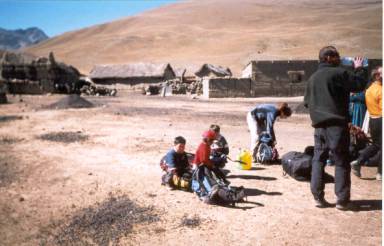
We left La Paz in mid morning for the two-hour ride to the Tuni trailhead, the starting point for the trip to the Condoriri cirque. We were using the same outfit that provided transport for the Huyana Potosi climb but instead of utilizing a hut to climb from, we would hike from the drop off point to the far end of a high lake, about four miles distant. Fortunately, we would again have the services of porters, this time the four-legged variety that would carry the group gear while we were responsible for the personal stuff.
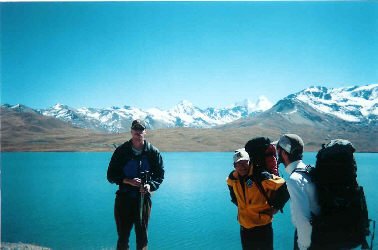
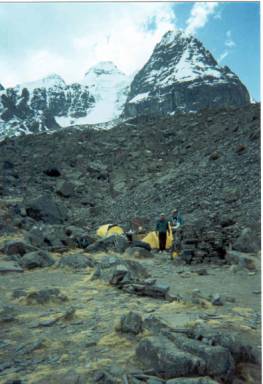
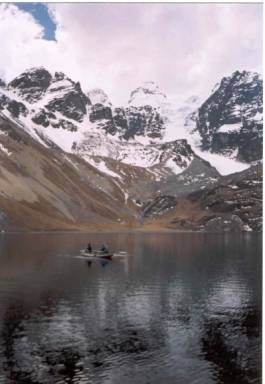
The route to the cirque skirted along the retention structure of a large reservoir, part of La Paz’s water scheme, before becoming a dirt track. The track clings to the gently sloping valley wall, passing herds of grazing sheep tended by small children and clumps of alpacas and llamas grazing on the higher slopes. The valley floor was home to small farms, again comprised of mud structures, and though few people were seen out and about, we could tell that even this remote valley had a good number of inhabitants. The walking track eventually led us to a white washed home sitting at the base of xxxx lake, the far shore of which would be our base camp for the coming week. We skirted the lake and found a campsite among the slabby boulders that formed the most recent terminal moraine, just above the lakeshore.
There was no shortage of campsites for the two dozen or so climbers who were in the cirque even though the terrain is comprised of course glacial rubble. The local populace and past climbers have flattened a number of areas, built rock wind walls, and provided for the camp’s overall sanitation needs. The sanitary facilities, holes in the ground with flat rock floors and waist high walls, provide a view like I have never enjoyed while assuming what had now become an almost natural squat. The mules soon arrived and we promptly erected the tents and started sorting the personal and group gear the next morning’s climb. Pequeno Alpamayo – August 5(description of later self guided climb and detailed route photos for Pequeno Alpamayo may be found in pages for 2007 Bolivia expedition
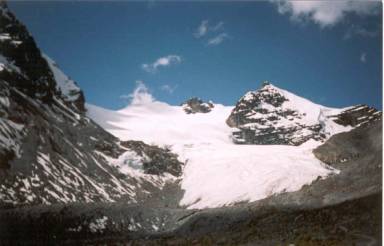
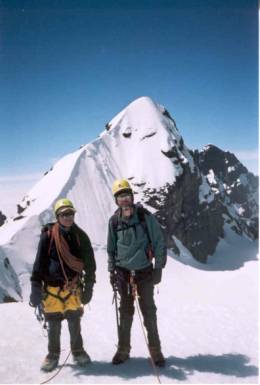
Three in the morning came early enough and with the now standard breakfast of oatmeal and sugar, we set off for Pequeno Alpamayo. This 17,450-foot peak is not visible from the lakeside camp but comes into view only when one reaches the summit of the adjacent Tierja peak. We trudged up the valley, Jim, Elrochio, and me on the leading team and after a mile long hike up the moraine filled valley, we roped up and headed onto the glacier. The trip up the glacier was completed in the dark and punctuated only by my need to stop for an early morning shit, quite a trick when attached to two other people on a rope. That essential task accomplished, we continued to the saddle below Tierja Peak, crossing a few small crevasses on the way.
We made the saddle as dawn broke and took a short break to eat and drink a bit before continuing toward the summit of Tierja. The slope up to the summit of Tierja was lightly crevassed and though not that much of a climb, was a major challenge for me as I was having a very bad day. We arrived at the flat preceding the summit of Tierja and had only to make a short belayed crossing of a short knife-edge ridge before we started our descent to the saddle connecting this sub peak to the base of the climb to the summit of Pequeno Alpamayo. The view from Tierja was impressive and included not only a spectacular view of the other Condoriri peaks but Huyana Potosi and again the Amazon basis toward the east.
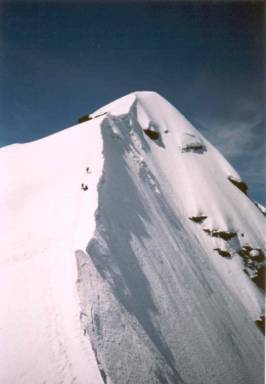
We dropped off the rounded summit of Tierja and down climbed the Class 3 or 4 terrain to the saddle connecting the two peaks. We did not stay on the high line but dropped down further to skirt the base of an intermediate peak before arriving at the start of the slope leading to the summit of Pequeno Alpamayo. The fist portion of the ridge was just a snow walk but after the subpeak, the terrain takes a more interesting character when you cross another knife edge, this time staying to one side and being able to almost see through the thin translucent ice to the dropoff just to the other side. Here and there, we say ice axe poke throughs and we ensured that our foot placement was shy of those thin zones.
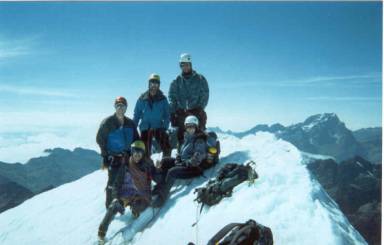
From the base of the climb up Pequeno Alpamayo, we made a belayed climb up the slope, generally sidestepping but also front pointing our way up few steep pitches. The ridge undulates to some extent, providing alternating steep and more shallow sections, generally making the change right about the time you tire of the front points or come to the concusion that side stepping just isn’t doing the trick. Our pace was steady and with the other rope team following, we drove pickets and made our way up segment by segment, until we stood upon the small-sloped summit. About 20 minutes later, the second team arrived.
Pictures and a bite to eat, then it was time to start the multi-hour trip back to the camp. We descended, again protecting each pitch, until we were at the saddle and able to traverse back to the rock pitch leading back up to Tierja's summit. We belayed the climb up Tierja though the effort was not really necessary though the class 3 terrain. Up and over, we recrossed the short knife-edge, and then made our way down the other side and back onto the major portion of the glacier for the few hours walk needed to return to the camp below. Fishing Trip – August 6
Our day off was just that, a day with little to do but eat, drink, and rest up, so we went fishing. The owner of the white house has a boat on the lake from which he nets the trout of dinner fare. He was not around but I was able to convince his son to let us take the boat for a paddle around the lake, spinning rod included. I ended up as the paddler for the initial traverse of the lake, disembarking at the white house, as Gary and Jim paddled about and fished without success.
We also arranged another fish fry for that night, wandered semi aimlessly around, and played cards. We formulated a plan for the last climb of the trip, which was supposed to be La Cabeza de Condor, an 18,500-foot peak known for its beauty and challenging knife edged summit ridge. We had to decide however, was this to be a training trip or a score the summit trip. Gary had led his rope team up Pequeno Alpamayo, route finding and setting the protection for the group. Now I wanted to gain the same experience so that when both Gary and I climb in Colorado or again outside of the U.S., both of us would be able to lead on steep snow or a moderate glaciated peak climb. Given that goal, Dan, Gary, Jim and I agreed that I would lead a four-person rope team on a climb of Pyramida Blanca, another 17,000-foot peak near Tierja. Anne and Elrochio in the meantime would take a shot at the Condor in a two-person rope team, the best size for the exposure, trip duration, and rigors of the knife-edge summit ridge. That was the plan for the next day and we all knew that 3 a.m. would come all too soon.
|